CARL Webinar: Rights in the Age of Generative AI // Webinaire de l’ABRC : Les droits des utilisateurs à l’ère de l’IA générative

Title: User Rights in the Age of Generative AI

Speaker: Professor Peter K. Yu [Bio]

Date: February 25, 2026

Time: 1:00pm ET

Registration required

Since the Supreme Court of Canada’s 2004 decision in CCH Canada Ltd v Law Society of Upper Canada, the global copyright landscape has changed considerably. While a number of jurisdictions have transplanted, or considered the transplantation of, a fair use or user right regime from abroad, other jurisdictions have actively introduced express copyright exceptions to support text and data mining and the creation of parodies, satires, caricatures, and pastiche works.

Read More

Copyright Office Hours

Is there something you’ve always wondered about copyright but were afraid to ask? Stop by the Libraries and chat with our Copyright Librarian! In honor of Fair Use Week, we’ll be tabling in Main Library to share copyright resources and answer any questions you might have, like “Do I own a copyright?” “Can I use this in my project?” and more. Note: The Copyright Librarian is not a lawyer and cannot provide legal advice.

Location: Northwestern Main Library Corridor/The Street

SUBCINEMA Presents THE TIMEKEEPERS OF ETERNITY

In honor of REMIX CULTURE WEEK 2026 — where we advocate for the importance of collage and appropriation in movies and art — we’re screening a new cut-up classic on VHS. Taking Stephen King’s 1995 TV-miniseries THE LANGOLIERS and printing each frame onto Xerox paper, filmmaker Aristotelis Maragkos animates a brand new, hour-long remix creature feature unlike any other. We’ll kick off the show with some select 16mm shorts projected by Flea Market Films, and make sure to join us beforehand and browse the stacks at Bottom Feeder Books.

Doors open 6:30 PM. Show starts 7:00 PM.

Location: Pittsburgh, PA

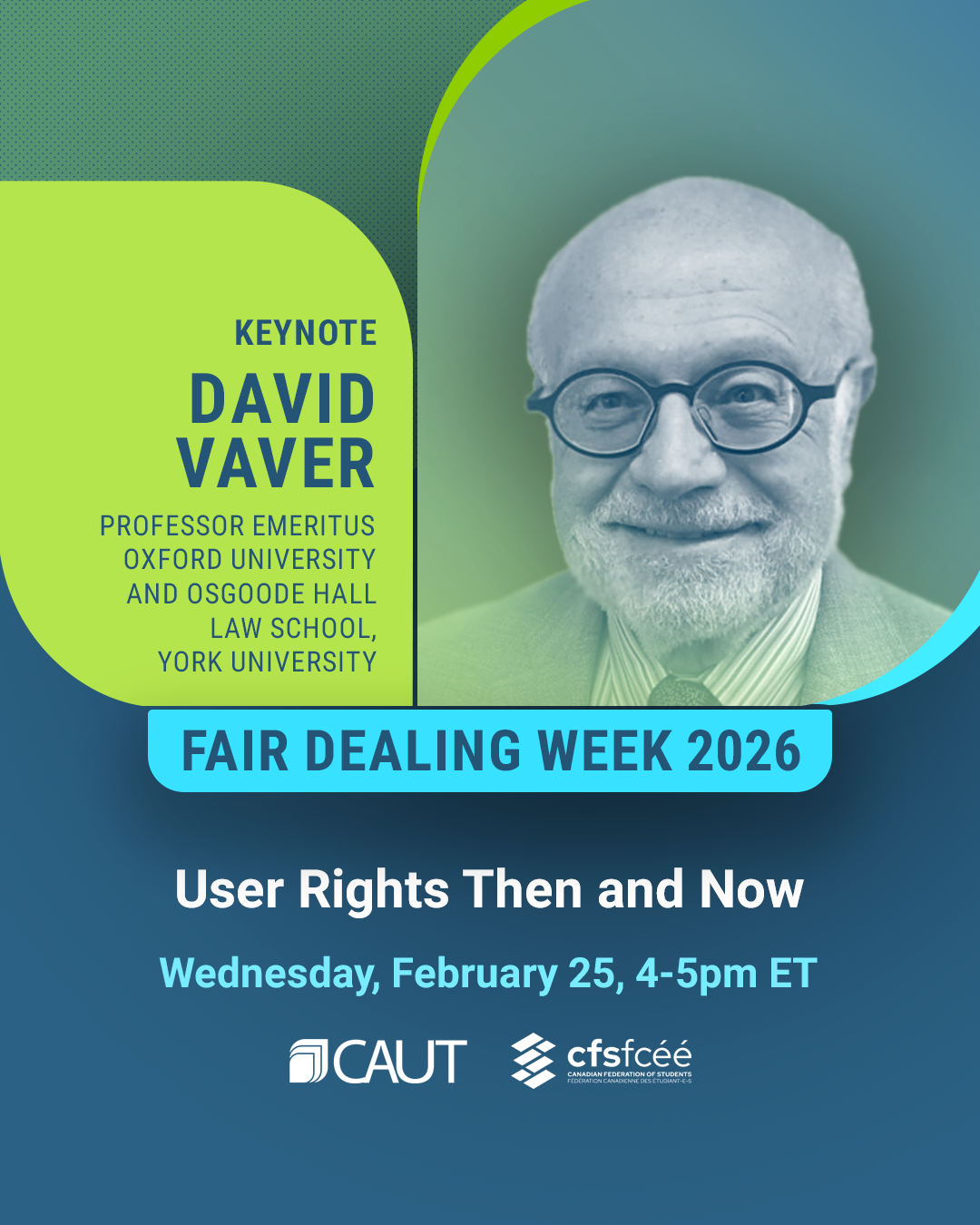
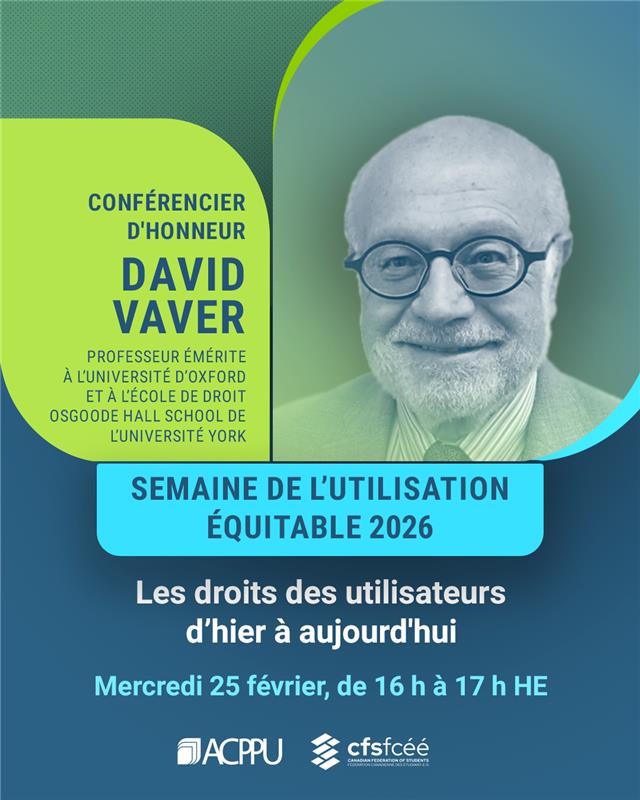
Virtual Keynote Featuring Prof David Vaver Speaking On “User Rights Then and Now”

David Vaver is a leading copyright expert and Professor Emeritus at Oxford University and Osgoode Hall Law School. The title of his keynote is “User Rights Then and Now.” The event will take place online on Wednesday, February 25, 2026, from 4:00 PM to 5:00 PM (Eastern Time). To participate, please use the registration form. Simultaneous interpretation to French will be available.

https://us06web.zoom.us/webinar/register/WN_v7NJCl3qREywyWVVdq_pqQ#/registration

Register for the event at the above link. If there are any additional questions, please contact Andrea Stuart at stuart@caut.ca, Canadian Association of University Teachers (CAUT)

Promotional poster for "Fair Dealing Week 2026: User Rights Then and Now" with an image of David Vaver.French language promotional poster for "Fair Dealing Week 2026: User Rights Then and Now" with an image of David Vaver.

Two Questions on Fair Use: Interview with Nabiha Syed

For this year’s Fair Use/Fair Dealing Week, MediaWell is partnering with the Association of Research Libraries to interview experts reflecting on how fair use supports research, journalism, and truth. This is the fourth and final installment of MediaWell’s four-part series, entitled “Two Questions on Fair Use.” In this interview, we ask Nabiha Syed, president of The Markup, about how the problem of misinformation requires discretion from people looking to exercise fair use, and how fair use supports people who share information independently.

Read the interview on MediaWell’s website.

Can fair use help combat misinformation on social media?

One of the things I love about fair use is that it creates this carve out from a copyright infrastructure that otherwise could pose a lot of downstream restrictions for a creator or a commentator or a person engaging in a critique. That’s the reason why Justice Ginsburg said that fair use doctrine was a built-in free speech safeguard. We want to engage with cultural conversation, with topics of great public interest, and we want to be able to point to them and say, “I’m not sure I agree with that,” or “there’s a detail that’s missing here, or “let me tell you about how my research really supports this in a way that might be counterintuitive.”

What’s tricky about misinformation is that while you can say, “Let me take snippets of the misinformation and rebut it or debunk it, or fact check it,” fair use permits you to do that. But there’s an open question about whether the psychological research actually supports that as a good thing to do.

Fair use clears the way for us to be able to say, “Okay, here is a rumor that’s spreading about how JFK Jr. is going to come back and turn Donald Trump into the president,” which I think was circulating a couple months ago. We can take that snippet because fair use allows us to, and have that clip or take that quote and comment on it, which is all well and good and should happen. But in a journalistic environment, do we want to be recirculating it? Do we want to be amplifying it? These are a really interesting set of questions. I’m not sure it’s the right tactic, but I’m glad that fair use at least gives us the chance to engage.

For researchers who are working on a different time horizon than journalists, the ability to really dig in, to create a historical record of this kind of misinformation, to document how it flows, that wouldn’t be possible without fair use. For that use case, I think it’s tremendously necessary to document this strange time that we’re in, and the many flavors of misinformation. But for the news journalistic context that I operate in, I worry a little bit about just because you can, doesn’t mean you should.

Read More

Fair Use/Fair Dealing Week Day 3 Roundup

This year, libraries, universities, and civil society groups celebrate Fair Use/Fair Dealing Week February 21–25.

Fair use (in the US) and fair dealing (in Canada and other jurisdictions) is a right that allows the use of copyrighted materials without permission from the copyright holder under certain circumstances. Association of Research Libraries (ARL) President K. Matthew Dames, the Edward H. Arnold University Librarian for the University of Notre Dame, says of fair use: “Fair use is an indispensable tool allowing librarians, researchers, journalists, and the public to access and use copyrighted original sources, which is critical to understanding the truth of any issue. Along with rights that Congress specifically granted to libraries, fair use propels the advancement of culture and knowledge, which is the fundamental purpose of copyright.”

Read More

Fair Use Jurisprudence Project—Updated for 2022

**Cross-posted from https://ipat.law.uci.edu/fairuse22/**

By

Pie chart of fair use opinions by court name and state.

Fair Use Opinions by Court, January 1, 2019–February 8, 2022

Last year, in celebration of Fair Use Week, the IPAT clinic took a deep dive into fair use. We looked at every written judicial opinion that discussed fair use from the beginning of 2019 through February 2021, and made them available in a searchable, sortable database with abstracts and commentary and links to copies of every single case. We learned a lot, and the resources we made available were used by many scholars, students, and attorneys across the country.

Read More

Two Questions on Fair Use: Interview with Alex Abdo

For this year’s Fair Use/Fair Dealing Week, MediaWell is partnering with the Association of Research Libraries to interview experts reflecting on how fair use supports research, journalism, and truth. This is the third of MediaWell’s four-part series, entitled “Two Questions on Fair Use” in which we ask Alex Abdo, the litigation director of the Knight First Amendment Institute at Columbia University, about the key issues surrounding researchers’ and journalists’ access to data, as well as legislative efforts to promote platform transparency for researchers. The transcript has been lightly edited for clarity.

Read the interview on MediaWell’s website.

What would you think are the key issues for scholars and journalists to know right now about access to data?

One of the most important subjects of research at the moment is our online world, and researchers and journalists are trying to educate the public about what our new online sphere portends for society. Is public discourse online being manipulated or distorted by the platforms that host and curate conversations online, or by malicious third parties who try to hijack conversations or hijack the machinery of content moderation to advance their agenda at the expense of the public interest?

But it is extremely difficult to study those questions because you need data to study them, and the platforms, for their part, tend to be pretty stingy in the data they make available to researchers and journalists. And so there are many, many journalists and researchers now who try to study the platforms independently, by acquiring data through their own means, either by recruiting volunteers to their studies to enable research, or by collecting data directly themselves for their studies.

The problem is that the platforms tend to view those kinds of activities as violations of their terms of service; they tend to view them as illegal. And the platforms, and I’m mainly thinking of Facebook here, have threatened researchers and journalists who engage in these public interest investigations with cease-and-desist letters, threats of litigation, with the effect of shutting down some of these individual research projects or causing them to change in ways that make them less useful to the public.

Maybe even more troubling is the fact that these threats cast a broader chill on the research community. There are many researchers who don’t take up these sorts of investigations because they don’t want to have to worry about a corporate behemoth like Facebook sending them a legal threat and a legal demand that they don’t have the resources or the institutional backing to fight. So that, to my mind, is one of the most important areas where we need research and study, but where corporate terms of use have created an enormous blind spot for humanity.

Read More

Fair Use/Fair Dealing Week Day 2 Roundup

This year, libraries, universities, and civil society groups celebrate Fair Use/Fair Dealing Week February 21–25.

Fair use (in the US) and fair dealing (in Canada and other jurisdictions) is a right that allows the use of copyrighted materials without permission from the copyright holder under certain circumstances. Association of Research Libraries (ARL) President K. Matthew Dames, the Edward H. Arnold University Librarian for the University of Notre Dame, says of fair use: “Fair use is an indispensable tool allowing librarians, researchers, journalists, and the public to access and use copyrighted original sources, which is critical to understanding the truth of any issue. Along with rights that Congress specifically granted to libraries, fair use propels the advancement of culture and knowledge, which is the fundamental purpose of copyright.”

Read More

Two Questions on Fair Use: Interview with Rebekah Tromble

For this year’s Fair Use/Fair Dealing Week, MediaWell is partnering with the Association of Research Libraries to interview experts reflecting on how fair use supports research, journalism, and truth. This is the second of MediaWell’s four-part series, entitled “Two Questions on Fair Use” in which we ask Rebekah Tromble—director of the Institute for Data, Democracy & Politics and associate professor in the School of Media & Public Affairs at George Washington University—about how fair use enables computational social science research, but also how limitations on fair use imposed by social media platforms constrain research and teaching about political discourse online.

Read the interview on MediaWell’s website.

How does the copyright environment affect what kind of research & scholarship is conducted, and why does this matter for society? For democracy?

I think that I can share from my perspective, as someone who studies political information and political discourse in the digital space, meaning everything from blogs, to websites, to of course social media, but also mass media that’s produced online and shared online. The rules and regulations around copyright, in many instances, wind up making the kind of core scientific endeavor quite challenging, particularly because under the best practices of the scientific method, you would ideally share the core data, the baseline data, so that others can deeply investigate the work that you’ve done and ensure that you’ve followed the proper methodology and replicate it as appropriate.

In the area that I work in, computational social science, we’re doing a lot of things like building out algorithmic models to detect and understand various concepts or various phenomena. Having that underlying data available is essential. It’s really, really important. And so we’re sometimes hindered by the fact that, for example, if I’m using a great deal of data pulled from mass media outlets, news organizations, websites, I very often can’t share that with other researchers. Those who are on my team can also work with that data, but copyright rules and regulations prevent us from sharing it with other researchers outside of our team, and so the scientific process winds up being hindered. The sort of questions that we’re investigating are about the spread and impact of disinformation. Understanding the types of political discourse that are happening in a variety of spaces online is really essential to our deeper understanding of both the health and wellness, and on the other hand, the harms that are occurring within our democratic societies.

Read More